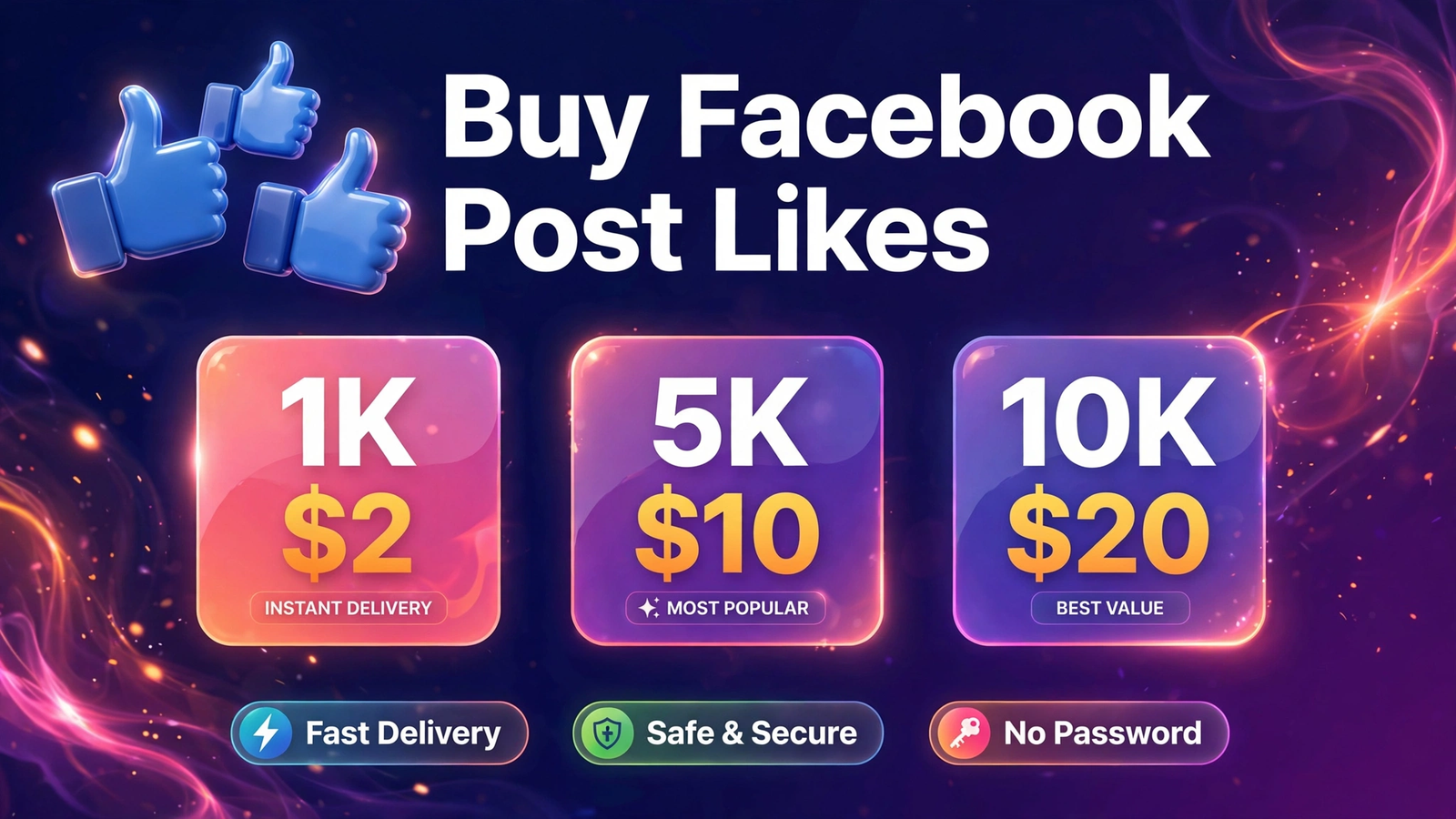
Should I Buy Facebook Post Likes? The Honest Answer
Should I buy Facebook post likes? Yes — when one specific post needs instant social proof, such as a product launch, a pinned announcement, or a post on a brand-new page that currently looks empty. No — when your page runs Facebook ads or depends on organic reach, because fake likers poison ad targeting and dilute your engagement rate. Either way, buying likes is inauthentic behaviour under Facebook's Community Standards, although the common outcome is the like count falling back, not a page takedown.
That split verdict is the sharpest way to think about the whole decision. Post likes unlock trust on arrival: a stranger landing on your post sees 500 likes and assumes the content is worth their attention. Page followers, by contrast, unlock distribution over time: a larger audience gives each new post more initial viewers. Buying post likes for the post is using the right tool for the job; buying page likes and expecting your reach to grow is using the wrong one.
To turn the verdict into a decision, ask yourself two questions. First: will real people judge my business by this specific post? If it is your pinned post, your launch announcement, or the post in your pinned offer ad — yes. Second: does my page spend money on Facebook ads or live on organic reach? If yes, bought likes on boosted or widely-distributed posts will cost you more than they save. Run those two tests and the answer writes itself.
What Are Facebook Post Likes, Exactly?
A Facebook post like is a thumbs-up reaction clicked on one individual post — not on your page, not on your profile. Post likes measure how much attention a single piece of content received, while page likes and followers measure the size of your audience. Bought post likes are likes that a seller adds to one specific post URL from its own network of accounts, usually over hours rather than all at once.
The distinction matters because sellers list three different products and buyers mix them up constantly. Post likes attach to a single post and change only that post's like count. Page likes attach to your page and change its total like count. Page followers attach to your page and determine how many people are subscribed to your updates. Ordering page likes when you wanted post likes means the money goes to the wrong counter — always check which counter your package targets before you pay.
There is also a second distinction worth knowing: instant likes versus real likes. Instant likes are the cheapest tier — bulk accounts, fast delivery, the highest drop rate. Real likes (sometimes labelled "high-quality") come from older, profile-complete accounts and cost more at every seller. If you buy, the real tier is almost always the better value, because instant likes vanish fastest when Facebook runs its periodic fake-engagement purges.
When Buying Post Likes Makes Sense
Buying post likes makes sense in three situations: social proof on key posts that cold visitors will judge your business by, launch credibility when a new product or offer needs to look established on day one, and making a brand-new page look alive so early visitors do not bounce. In each case the likes fix a first-impression problem — nothing deeper, and nobody should pretend otherwise.
The first situation is the key-post scenario. Your pinned post, your best offer, the testimonial video you send every new lead to — these are the pages where a like count of 3 quietly works against you. A modest bought package here (a few hundred likes, not tens of thousands) brings the count up to what a real, healthy post would have, so visitors judge the content instead of the counter.
The second is launch credibility. When you launch a new product, service, or local business page, the first visitors arrive while the page is empty — the digital equivalent of an empty restaurant at lunchtime. A one-off package on your announcement post removes that friction. Pair it with genuine launch-day activity (replies to every comment, a share to your personal profile) and the bought likes just do the quiet job of making the room look occupied.
The third is the new-page problem: a page with 12 followers and posts at 0–2 likes each looks abandoned to every real visitor, and many bounce without reading a word. Bought likes on your five or six starter posts buy you a credible-looking baseline while you do the real work of publishing. Think of it as stage dressing before the show starts — useful, temporary, and no substitute for the performance.
When Buying Post Likes Backfires
Bought post likes backfire in three ways. First, fake likers poison your ad targeting: Meta builds lookalike audiences from the people who engage with your posts, and dead accounts teach it the wrong profile. Second, a large bought base that never engages dilutes your engagement rate, which drags down future organic reach. Third, Facebook periodically detects and removes fake engagement, so the like count falls back in cycles unless the seller refills it.
The ad-targeting problem is the most expensive and the least discussed. When you boost a post or run a lookalike campaign, Meta asks: "who engaged with this content?" If 800 of your 1,000 likers are dead accounts from three countries, the algorithm optimises for more of exactly the wrong people — and you pay full ad prices to reach an audience that will never buy. This is why the rule is absolute: never buy likes on a post you plan to boost or use as ad creative.
Engagement-rate dilution works like this. Engagement rate is engagement divided by audience size, times 100. Suppose your page has 500 real followers and a post earns 25 likes from them: a healthy 5%. Add 10,000 bought likes that will never engage again, and the same post's rate against the inflated audience reads as a fraction of a percent. Facebook's ranking reads engagement rate as a quality signal, so the bought audience quietly teaches the algorithm that your content underperforms.
Finally, the removal cycles. Facebook's detection systems sweep for fake engagement on a rolling basis, and the typical result — confirmed by measured 2026 buying tests — is the like count on the post falling back, not the post or page being taken down. Likes that arrive spread over hours from real-looking accounts survive these sweeps far better than instant dumps, which is why gradual delivery and a refill guarantee matter more than any other feature on a seller's pricing page.
How Much Do Facebook Likes Cost in 2026?
Facebook post likes cost from about $2 per 1,000 at the budget end — igview's own post-like packages start at $2 for 1K — up to $8.99–$11.99 per 1,000 instant likes on mainstream seller sites (ilounge.com, 2026). UK-targeted likes cost more: megafollowers.uk charges £5.45 for 500 UK post likes with paced first-hour delivery, and followerspro.uk lists 100 for £1.99, 1,000 for £7.99, and 10,000 for £54.99.
If you want to buy facebook post likes uk specifically, budget £5–£15 per 1,000 rather than chasing the cheapest dollar packages. UK-targeted likes cost more because they come from a smaller, harder-to-source pool of accounts — but for a UK business, a like pool that looks British is far more credible to the customers who will actually visit your page than 10,000 likes from random countries.
Two pricing details most guides skip. First, "real" likes always cost more than "instant" likes at the same seller — that premium buys older, profile-complete accounts that survive purges longer. Second, the per-like price falls with volume, but only up to a point: buying 10,000 likes for a page that normally earns 30 per post is not a bargain, it is a credibility problem. Match the package to what your best real posts already earn, and spend the saving on the real tier instead of the biggest number.
Is Buying Facebook Likes Safe in 2026?
Many page owners type is buying facebook likes safe 2026 into Google before they buy — and it is the right first question. The honest answer: it is low-risk when four conditions hold: the seller asks only for your public post URL and never your password, delivery is spread over hours rather than dumped in minutes, the likes come from profile-complete accounts, and the seller offers a refill guarantee that replaces drops. The honest caveat: bought likes are inauthentic behaviour under Facebook's Community Standards, so "safe" means "unlikely to be penalised," not "within the rules."
Run this five-point checklist before you pay anyone:
- No password, ever. A legitimate seller needs only your public post link — a seller asking for login details is running a hijack scam.
- Gradual delivery stated upfront. Likes arriving over hours look natural; 5,000 likes in ten minutes is a bot pattern.
- Believable numbers. Keep the package close to what your best posts already earn — a 30-like post jumping to 10,000 looks wrong to everyone.
- A refill guarantee in writing. Some drop-off is normal as Facebook prunes accounts; the seller should replace drops free, ideally for 30+ days.
- Normal checkout. Card or wallet payment over an encrypted page — never bank transfers, gift cards, or crypto-only.
For the official position, skim the Facebook Help Center and the Meta for Business resources on authentic engagement before you buy. Meta's enforcement targets inauthentic behaviour patterns — spam networks and fake engagement rings — and a modest, gradual like order on a single post sits far below the patterns that attract real penalties.
Do Facebook Likes Help Page Growth?
Do facebook likes help page growth? Not directly. Post likes unlock trust on arrival — a post with 500 likes looks credible to a cold visitor — while page followers unlock distribution over time, because a bigger subscribed audience gives each new post more initial viewers. Buy post likes for the post's social proof; buy followers for the page's reach; never expect either one to grow the other.
This is the framing that clears up most confusion about bought engagement. A like on a post does not make Facebook show that post to more people in any lasting way — the 2026 algorithm rewards watch time, shares, and meaningful comments, not raw like counts. What a healthy like count does is convert the viewers you already have: visitors who see social proof stay longer, read further, and click through more often. That conversion effect is real, but it is a one-step effect, not a growth engine.
So where does actual growth come from? Followers give each post a larger initial audience, Reels remain Facebook's highest-distribution organic format, and consistent niche posting trains the algorithm on who to show your content to — our guide to how the Facebook algorithm works in 2026 breaks the ranking signals down in plain English. Buy the likes for trust, then build the engine with content; neither works well without the other.
Bought Facebook Likes: Pros and Cons
Bought facebook likes pros and cons come down to a short ledger. The pros: instant social proof on the posts that matter, launch credibility for new pages and offers, and a page that no longer looks abandoned — all for a few dollars and zero effort. The cons are equally real: fake likers can poison your ad targeting, a bought base dilutes engagement rates, Facebook periodically removes fake engagement in purges, and likes alone have never generated a single sale.
The fairest way to judge is against the alternatives. The table below compares the three realistic ways to get engagement on a Facebook post in 2026:
| Approach | Typical cost | What it gives you | Main risk |
|---|---|---|---|
| Buy post likes | From $2 per 1K (budget) to $8.99–$11.99 per 1K (mainstream sites) | Instant social proof on chosen posts; launch credibility | Like-removal cycles; poisons ad targeting if you boost |
| Organic content | Free — costs your time | Real audience, compounding reach, engagement that never gets purged | Slow: months before a new page looks established |
| Meta ad boost | From ~$1/day | Guaranteed impressions with precise audience targeting | Costs scale with ambition; needs basic ad skill to avoid waste |
Notice that the three approaches are not rivals — they are layers. The pages that win use bought likes as the thin top layer (social proof on key posts), organic content as the foundation (real audience), and Meta boosts as the amplifier (reach beyond followers). Anyone selling you likes as a complete strategy is selling you the garnish as the meal.
How to Buy Facebook Post Likes Safely: A 5-Step Checklist
To buy real facebook likes cheap without the usual headaches, follow this order of operations: start small with a package close to what your best posts already earn, pick a seller that needs only your post URL, choose gradual delivery over instant, keep every number believable, and buy only where a refill guarantee is stated in writing. Each step is explained below.
Step 1 — Size the package to your real numbers. Look at your best-performing post from the last month and pick a package near that count. A page earning 40–80 likes per post should buy 100–500, not 5,000. Believability is a safety feature, not just an aesthetic one.
Step 2 — Choose the post. Pick one key post — your pinned post, launch announcement, or best offer — and copy its public URL. The post must be public; sellers cannot deliver likes to private or friends-only posts.
Step 3 — Vet the seller. Confirm three things before checkout: the seller asks only for the post URL (no password), delivery is described as gradual or paced over hours, and a refill guarantee is stated in days. If any of the three is missing, move on — the market is crowded enough that you never need to gamble.
Step 4 — Pay normally and keep the receipt. Use a card or wallet checkout, save your order number, and screenshot the package details. You will need the order number if you ever claim a refill.
Step 5 — Monitor and claim refills. Check the post's like count after a week and again after a month. If it has dipped, contact the seller's support with your order number and ask for the guaranteed refill. Reputable sellers replace drops without argument — a seller that ghosts you on refills is one to never use again.
Should You Buy Facebook Likes for Business Page Marketing?
Should you buy facebook likes for business page marketing? As launch garnish, yes: a business post with visible engagement converts cold visitors better than the identical post at zero likes. As a marketing strategy, no: any business that spends on Facebook ads should never buy likes on posts it plans to boost, because fake likers train Meta's audience targeting on the wrong people and waste real ad money.
The business-specific risk is precision. A local plumber's page and a national e-commerce brand have different audiences, but bought likers are generic — they tell Meta's algorithm that your ideal customer is "anyone with a pulse." If you later run lead ads or lookalike audiences from that post's engagement, you are paying to find more of the wrong people. Keep bought likes strictly on organic-only posts: pinned announcements, testimonials, and social-proof posts you will never put ad spend behind.
For the day-to-day marketing that actually fills a pipeline, the free tactics beat buying every time: post the formats Facebook distributes best, reply to every comment within the first hour, and publish on a schedule your audience can rely on. Our guide on how to increase Facebook engagement without ads walks through ten of them, including the native invite tactic covered below.
Safer Alternatives That Cost Less Than You Think
The two safest alternatives to bought likes are boosting your best-performing posts with a few pounds of Meta ad spend, and inviting people who already engaged with your posts to like your page — a free, native Meta tactic most page owners never use. Both build real engagement that no bot purge can remove, and both work fine alongside an occasional bought-like package for social proof.
Boosting works because you are paying the platform, not fighting it. Take the post that already earned the most organic likes this month and boost it to a tightly defined audience — £3–£5 a day for a week is enough to test. The likes you gain are from real people in your target market, they count toward lookalike audiences correctly, and they never get purged. It is the closest thing to buying likes with none of the downsides.
The invite tactic is genuinely free and takes two minutes. Open any post with decent engagement, click the reaction count to see who liked it, and click "Invite" next to each name — Facebook sends them a page-like invitation. These are warm prospects who already liked your content, so they convert at a far higher rate than cold outreach. Do this weekly and your page grows a real audience while the bought likes quietly handle first impressions.
Frequently Asked Questions About Buying Facebook Post Likes
Yes, if a specific post needs social proof - a product launch, a pinned announcement, or a new page that looks empty. No, if you run Facebook ads or depend on organic reach, because fake likers poison ad targeting and dilute engagement rates. Buying likes is against Facebook's rules, but the usual outcome is removal of the likes, not a page takedown.
It is low-risk when the seller needs only your post URL, delivers gradually, and offers a refill guarantee. It is not safe in the sense of being allowed: bought likes are inauthentic behaviour under Facebook's Community Standards. Keep orders modest and believable, never share your password, and check the Facebook Help Center for the current official policies.
From $2 per 1,000 at the budget end to $8.99-$11.99 per 1,000 instant likes on mainstream seller sites (ilounge.com, 2026). UK-targeted likes cost more: megafollowers.uk charges £5.45 for 500 UK post likes, and followerspro.uk lists 1,000 for £7.99. igview's post-like packages start at $2 for 1,000 likes.
Not directly. Post likes unlock trust on arrival - a well-liked post looks credible to cold visitors - while followers unlock distribution over time by giving each post more initial viewers. Buy post likes for a post's social proof; grow reach with followers, Reels, and consistent posting instead of expecting likes alone to grow the page.
Often, yes. Facebook detects and removes fake engagement, and the common outcome is the like count on the post falling back rather than the post being taken down. Likes spread over hours from real-looking accounts are removed less often than instant dumps. Choose a seller with a refill guarantee so dropped likes get replaced free.
Extremely unlikely. Buying post likes is inauthentic behaviour under Facebook's Community Standards, but enforcement normally means removing the fake engagement, not banning the page. No page is taken down for a few hundred bought likes. The real dangers are scam sellers who steal logins and wasted ad spend, both of which this guide's checklist helps you avoid.