Is It Safe to Buy YouTube Views in 2026?
Is it safe to buy youtube views 2026? Bot-driven views are not safe: YouTube's Fake Engagement Policy explicitly bans anything that artificially increases view counts, and YouTube strips detected fake views — or penalises the channel. Ad-driven views bought through Google Ads are policy-compliant and carry no penalty. The safety of any order comes down to which of those two products you actually receive.
That is the honest two-product answer almost nobody in this market gives you. There is no single thing called "bought views" — there is a legitimate product (paid promotion through Google's own ad system, where real humans choose to watch) and an illegitimate one (bot networks, click farms, and automated scripts that pump a counter). Sellers mix both behind identical price pages, so the buyer has to know which one they're holding.
The market split is extreme. Almost every "best sites to buy YouTube views" ranking page is an affiliate listicle or a seller page in disguise — none of them is a genuinely neutral guide. That is exactly why this guide exists: to give you the real policy in plain English, the real prices, and a way to tell which product you've been sold before YouTube tells you for you.
| At a glance | Bot views (cheap panels) | Ad-driven views (Google Ads) |
|---|---|---|
| Policy status | Violates the Fake Engagement Policy | Fully policy-compliant |
| Do the views stick? | Usually stripped in YouTube's view audits | Count normally like organic views |
| YouTube Studio | Odd traffic spikes, near-zero engagement | Appears under "YouTube advertising" traffic source |
| Price signal | Suspiciously cheap per 1,000 views | Costs more per view |
| Worst-case risk | Strike, demonetisation, channel termination | None — beyond the ad spend itself |
What Does YouTube's Fake Engagement Policy Actually Say?
YouTube's Fake Engagement Policy is the rule that bans artificially inflating views, likes, comments, or subscribers — including through automated systems, bots, or serving your video to unsuspecting viewers. YouTube states that content and channels which break this policy can be terminated and removed from the platform.
Read the official Fake Engagement Policy on YouTube Help and the wording is unusually direct for a platform policy. It says YouTube doesn't allow anything that artificially increases view, like, comment, or other metrics — either by using automatic systems or by serving videos to people who didn't ask to watch them. Content that solely exists to incentivise engagement is prohibited too, and repeat offenders can lose their channels entirely.
Two details in that policy are the ones buyers always miss. First, "artificially increases" covers the buyer as well as the bot operator — paying someone else to inflate your views is still artificial inflation. Second, YouTube warns explicitly: if you hire someone to promote your channel, their decisions may impact your channel. Outsourcing the risky part to a seller does not outsource the penalty.
The policy also draws a clean line between prohibited and legitimate engagement. YouTube considers engagement legitimate when a human viewer's primary intent is to authentically interact with the content — and illegitimate when it results from coercion, deception, or the sole purpose being financial gain. An advert that puts your video in front of interested viewers passes that test; a bot farm never does.
Can You Get Banned Buying YouTube Views?
Can you get banned buying youtube views? Yes — YouTube can terminate channels that repeatedly break the Fake Engagement Policy, and lesser penalties are far more common. The typical enforcement ladder runs from fake views being stripped, to a Community Guidelines strike, to demonetisation, and finally to channel termination for repeat or egregious violations.
In practice, most buyers don't get banned on day one — they get quietly punished. The first sign is usually a view audit: the counter freezes for hours or a chunk of recent views disappears overnight. Sellers call this "drop-off" and blame YouTube's mood; what's actually happening is YouTube's systems identifying the artificial traffic and removing it. A strike or demonetisation tends to follow when the pattern repeats across multiple videos.
There is also a legal layer most guides skip. In 2019 the US Federal Trade Commission settled with Devumi — a company selling fake followers, likes, and YouTube views — in a $2.5 million enforcement action, its first-ever case challenging the sale of fake indicators of social media influence. The target was the seller, not individual buyers, so a small buyer is unlikely to face regulators — but the case shows authorities treat fake engagement as deception, not a victimless shortcut.
The honest risk profile, then: a single modest order from a careful seller rarely kills a channel, but it is never zero-risk. Channels applying for the Partner Programme, running their own YouTube ads, or already carrying strikes should treat bot views as off-limits entirely — their accounts are exactly the ones under the closest scrutiny.
Do Bought YouTube Views Count?
Do bought youtube views count? Ad-driven views from Google Ads count like normal views and show up in YouTube Studio under the "YouTube advertising" traffic source. Bot views usually don't: YouTube runs view audits that strip views it identifies as artificial, which is why view counts sometimes freeze for hours or suddenly drop after a cheap order.
How YouTube counts a view is deliberately opaque — the company doesn't publish the exact threshold — but the shape of it is well understood: a real person has to deliberately play the video, and the audit systems then filter the playback for signs of artificiality. A view from someone who watched thirty seconds of a TrueView ad and stayed for the video passes every check. Ten thousand "views" from a server farm in a data centre do not.
The tell-tale signature of bot views is the ratio, not just the number. A video showing 50,000 views with 4 likes, 0 comments, and no new subscribers is an impossible pattern for real human traffic — bots don't engage, so the engagement metrics stay frozen while the view counter climbs. YouTube's systems read exactly that mismatch, which is why bought views so often come with bought likes bundled in (a topic our YouTube likes guide covers separately).
If your view count drops or freezes after an order, that's the audit working — and it's your signal to use the seller's refill guarantee or, better, to stop ordering from that source. A legitimate seller expects audits and replaces stripped views; a scam seller blames you and disappears.
Should You Buy YouTube Views for Monetization?
Buy youtube views for monetization is a risky strategy: the YouTube Partner Programme requires 1,000 subscribers and 4,000 valid public watch hours, and YouTube explicitly withholds or adjusts earnings tied to fake engagement and invalid traffic. Bot views do not move you closer to monetisation — they can set you back by triggering a review, an earnings hold, or a rejection of your Partner Programme application.
The keyword in the requirement is valid watch hours. YouTube's monetisation policies state plainly that earnings linked to fake engagement or invalid traffic can be withheld, adjusted, or charged back — with payment delays of up to 90 days while cases are investigated. A channel that buys its way to 4,000 hours with bot traffic is building its eligibility out of hours that YouTube is specifically allowed to erase.
Ad-driven views are the exception that proves the rule: views from Google Ads campaigns are legitimate traffic, they count toward public metrics, and the watch time they generate is valid for the Partner Programme. That's precisely why serious channels treat Google Ads as a marketing expense and bot panels as a liability — same word ("views"), opposite outcomes.
The practical recommendation: if monetisation is the goal, never let bot views near your channel. Use Google Ads for paid reach, or grow organically with a real system. And never buy subscribers alongside views to hit the 1,000-subscriber threshold faster — fake subscribers are stripped just like fake views, and a subscriber purge right before your application is the worst possible timing.
How Much Do YouTube Views Cost in 2026?
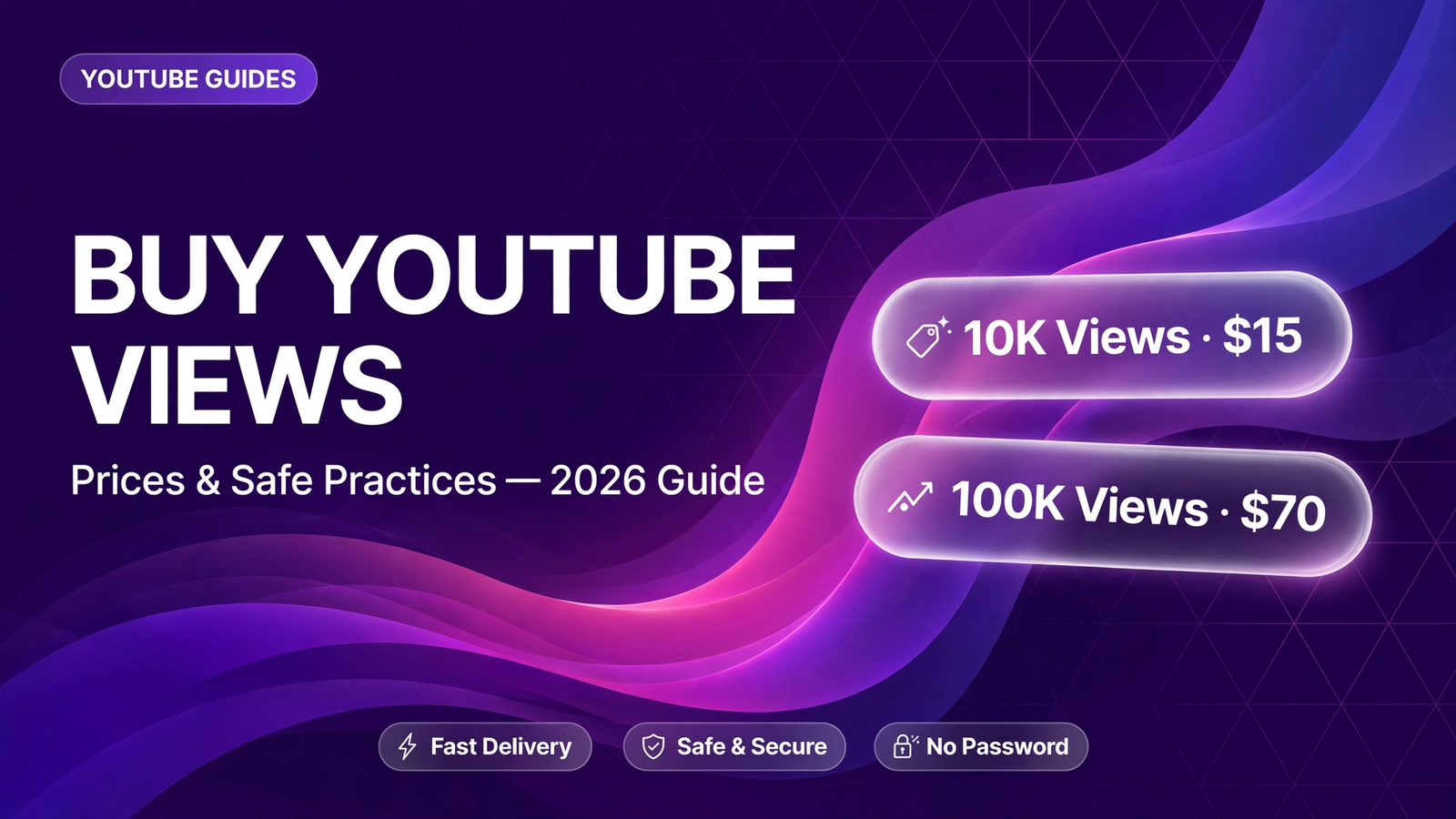
How much do youtube views cost? At SocialBoost, YouTube view packages start at $15 for 10,000 views, with 50,000 views at $40, 100,000 views at $70, and 500,000 views at $300 — which works out to between $1.50 and $0.60 per 1,000 views depending on package size. Google Ads–driven views cost more per view but remain the only fully policy-compliant option.
The smartest way to compare sellers is price per 1,000 views, because package sizes vary wildly. Divide the price by the view count and multiply by 1,000: our 100K package at $70 works out to $0.70 per 1,000. Any seller quoting far below the normal band — for instance, "10,000 views for $3" — is, as industry analyses note, offering something mathematically impossible with real human traffic. That price point is a confession, not a bargain.
Two pricing details most buyers miss. First, volume discounts are normal: the per-view price legitimately falls as packages get bigger, because delivery overhead spreads across the order. Second, watch for the upsell ladder — "instant" views are always the cheapest tier at any seller, while slower, more natural-looking delivery costs more. If a seller charges extra for gradual delivery, they're at least being honest about which product is which.
For UK buyers, one more consideration: cheap international bot traffic often arrives with a geographic mismatch — views from countries that don't match your content's language or your channel's natural audience. That mismatch is itself one of the strongest fake-traffic indicators YouTube's systems look for, which is why geography is a safety factor, not just a vanity preference.
Where to Buy YouTube Views Cheap — Without Getting Scammed
Where to buy youtube views cheap? Start with the service cards at the top of this page — SocialBoost's view packages are priced from $15 per 10,000 views — and judge every seller by the same checklist: no password required, gradual delivery stated upfront, believable numbers, and a refill guarantee in writing. Any seller offering thousands of views for pennies is selling bot traffic that YouTube will strip.
Run this checklist before you pay anyone:
- No password, ever. A legitimate seller needs only your public video URL — a seller asking for login details is running an account-theft scam, not a view service.
- Gradual delivery stated upfront. Views arriving over hours or days look natural; 50,000 views in twenty minutes is a bot pattern.
- Believable numbers. Match the package to what your best real videos already earn — a 40-view video jumping to 100,000 looks wrong to viewers and to YouTube's systems.
- A refill guarantee in writing. Some drop-off is normal as YouTube prunes accounts; the seller should replace stripped views free, ideally for 30+ days.
- Normal checkout. Card or wallet payment over an encrypted page — never bank transfers, gift cards, or crypto-only payments.
Learn the red flags too, because the scam sellers all use the same script: impossibly cheap pricing, instant or near-instant delivery of huge numbers, vague talk of "proprietary methods" instead of naming a traffic source, guaranteed-viral promises no honest service can make, and views from countries that don't match your content. A seller that can't plainly tell you where its viewers come from has already told you everything you need to know.
One final filter: ask the seller a single question — "do these views come from Google Ads campaigns?" A yes with a straight answer is the compliant product. A dodge, a wall of jargon, or "we can't reveal our methods" is the bot product. The answer to that one question is worth more than a hundred reviews on the seller's own website.
Ad-Driven Views vs Bot Views: The One Distinction That Matters
The one distinction that matters is the traffic source: ad-driven views come from real humans who chose to watch through a Google Ads campaign, while bot views come from automated systems. YouTube treats ad-driven views as legitimate promotion and bot views as fake engagement — the first is a marketing channel, the second is a policy violation with enforcement attached.
This distinction is also how you verify what you received. Real ad-driven views are visible in YouTube Studio as the "YouTube advertising" traffic source, and they behave like normal views: some viewers like, comment, and subscribe, and audience retention shows a recognisable curve. Bot views arrive as an unexplained spike, often under "Direct or unknown", with flat engagement and retention graphs that look like a cliff edge.
The table below compares the four realistic ways to put views on a YouTube video in 2026:
| Approach | Typical cost | What it gives you | Main risk |
|---|---|---|---|
| Buy bot views | Cheapest per 1,000 — often suspiciously low | Fast view count; no real engagement | Views stripped in audits; strikes, demonetisation, termination |
| Buy ad-driven views | Higher per view (e.g. SocialBoost 10K from $15) | Real viewers via paid promotion; visible in Studio | Wasted spend if the video itself is weak |
| Run Google Ads yourself | You set the budget; cost per view varies by niche | Fully policy-compliant; precise targeting; valid watch time | Needs basic ad skill; costs scale with ambition |
| Organic growth | Free — costs your time | Real audience, compounding reach, engagement that never gets purged | Slow: weeks or months before a new channel looks established |
Notice that the middle two rows are the same product from different checkouts: buying ad-driven views from a reputable seller is just outsourcing a Google Ads campaign. If you can afford to learn the ads dashboard yourself, you keep the margin — but you also take on the targeting work, so there's no wrong answer, only an informed one.
How to Check What You Actually Got (YouTube Studio)
After any paid order, verify the views in YouTube Studio instead of trusting the counter. Real ad-driven views appear as the "YouTube advertising" traffic source with a normal engagement pattern; bot views show up as unexplained spikes with flat retention and frozen engagement. The five-minute check below tells you which product you received.
Step 1 — Open YouTube Studio and select the video. Go to studio.youtube.com, click Content, and open the video you ordered views for.
Step 2 — Check the traffic sources. Open Analytics, then the Reach tab, and look at "Traffic source types". If your paid views came from advertising, you'll see a "YouTube advertising" slice. Bot traffic typically lands in "Direct or unknown" or arrives as a spike with no identifiable source.
Step 3 — Read the engagement tab. Open the Engagement tab and compare: real viewers like, comment, share, and subscribe at recognisable rates. A video with 50,000 new views and no change in likes, comments, or subscribers received bots, whatever the seller promised.
Step 4 — Inspect audience retention. The Engagement tab's "see more" retention graph should show a natural decay curve — viewers dropping off over time. Bot views produce an unnatural pattern: a vertical cliff at the very start, because automated playbacks "watch" almost nothing before the session ends.
Step 5 — Watch for the audit, then act. If the view count freezes or drops in the days after the order, YouTube stripped artificial views. Contact the seller with your order number and claim the refill guarantee. A reputable seller replaces stripped views without argument; a seller that ghosts you on refills is one to never use again.
When Buying Views Makes Sense — and When It Doesn't
Buying views makes sense when a video needs social proof at launch — a new channel's first videos, a product video, or a video you're pitching to sponsors — and you buy modest, believable numbers from a safe seller. It doesn't make sense when your channel runs its own YouTube ads, is applying for the Partner Programme, or already carries strikes — in those cases, use Google Ads or organic growth instead.
The launch scenario is the classic one. A video sitting at 47 views looks dead on arrival; the same video at a few thousand views gets its thumbnail a genuine second look from cold viewers. Bought views here are stage dressing — they buy the video a fair chance to be judged on its content. They are not a growth engine, and anyone treating them as one is paying for a ceiling instead of a foundation.
The alternative worth considering first is a real organic system. Our companion guide to how to get more YouTube views in 2026 walks through a 12-way fix-it system — CTR debugging, hook structure for retention, the critical 24–48 hour launch window, and how to self-diagnose weak videos from YouTube Studio. And if you're deciding where to focus your effort, our YouTube Shorts vs long-form comparison breaks down which format actually serves your goal — subscriber growth, ad revenue, or both.
The honest bottom line: buy views for first impressions, grow with content for everything else. A channel with ten bought-looking videos and no organic strategy is a channel paying rent on an empty shop; a channel with one boosted launch video feeding into a real upload schedule is a business investing in its storefront.
Buy YouTube Views UK: What British Creators Should Know
To buy youtube views uk safely, apply the same rules as everywhere else — but add two UK checks: confirm the seller can deliver UK- or English-speaking traffic so your audience analytics stay meaningful, and remember that UK consumer protection covers the purchase itself (you can dispute a scam with your card provider) even though it can't make the views policy-compliant.
Geography matters for two practical reasons. First, your YouTube analytics segment viewers by country, and a British business whose "audience" is suddenly 90% non-English-speaking traffic has analytics that lie to every future decision. Second, if you ever monetise or pitch sponsors, UK brands pay for UK eyeballs — a view count built from the wrong countries actively hurts your media kit's credibility.
UK buyers also have one advantage: Section 75 and chargeback rights. If a seller takes your money and delivers nothing — or delivers views that YouTube strips within days and refuses to refill — your card provider can reverse the transaction. That protection covers the purchase contract, not the policy question: it can get your money back, but it can't make bot views compliant. Read it as a safety net for the wallet, not a permission slip from YouTube.
Frequently Asked Questions About Buying YouTube Views
Bot views are not safe: they violate YouTube's Fake Engagement Policy, get stripped in audits, and can bring strikes or demonetisation. Ad-driven views via Google Ads are the only policy-compliant option and count normally. If you buy, use a seller that needs only your video URL, delivers gradually, and offers a refill guarantee in writing.
Yes, channel termination is the top penalty for repeated Fake Engagement Policy violations. In practice, most buyers first see fake views stripped, then a Community Guidelines strike, then demonetisation. A single modest order from a safe seller rarely triggers termination, but no bot-view purchase is risk-free — only Google Ads views carry zero policy risk.
Ad-driven views count normally and appear in YouTube Studio under 'YouTube advertising'. Bot views usually get stripped in view audits before they help, and YouTube withholds earnings linked to invalid traffic. If monetisation is your goal, bot views can actually set you back by triggering an earnings hold or a Partner Programme rejection.
SocialBoost's packages start at $15 for 10,000 views ($1.50 per 1,000), dropping to $300 for 500,000 views ($0.60 per 1,000). Be wary of sellers far below that: '10,000 views for $3' is mathematically impossible with real human traffic and signals bot views YouTube will strip. Google Ads views cost more but are policy-compliant.
Compare sellers on price per 1,000 views, but treat rock-bottom prices as a red flag. A safe seller needs only your video URL — never your password — delivers gradually, and states a refill guarantee in writing. For the only fully policy-compliant option, run the views through Google Ads yourself or hire someone to manage a TrueView campaign for you.
No — 'real' is a marketing word, not a guarantee. Some sellers mean profile-complete accounts that still violate the Fake Engagement Policy; others mean ad-driven views, which are genuinely compliant. Ask the seller one question: where do the views come from? If they can't say 'Google Ads campaigns' in plain words, treat the claim as unsafe.