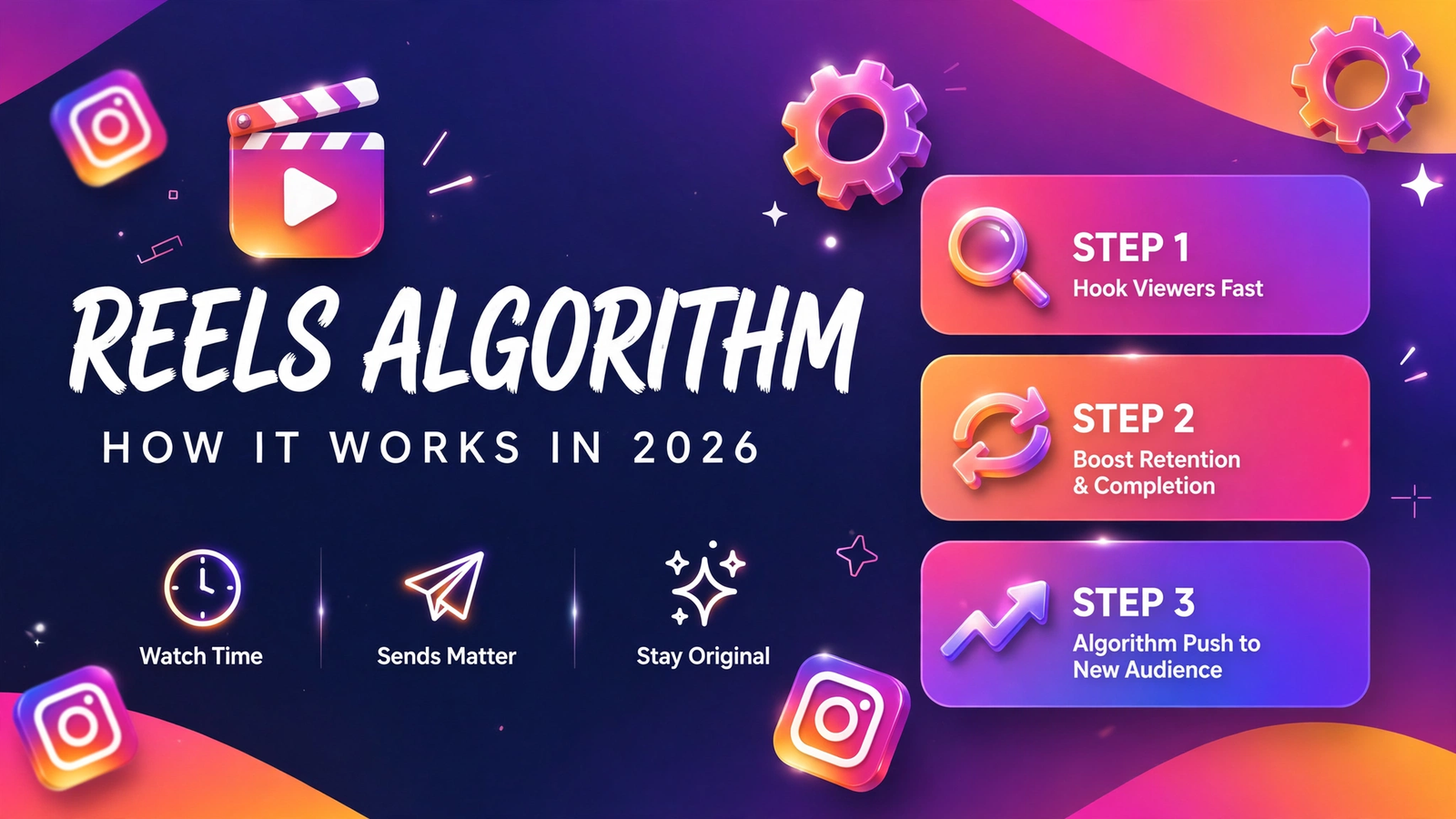
How Does Instagram Reels Algorithm Work 2026?
In one sentence: Instagram predicts how much each viewer will enjoy your Reel, shows it to a small test audience first, and expands distribution only if that audience watches, shares and engages. Nothing about the process is random — every Reel is scored, ranked and re-ranked continuously.
The question of how does Instagram Reels algorithm work 2026 comes up in almost every creator forum, and the confusion is understandable. The scale is enormous: more than 200 billion Reels are played every day, and Reels now account for around 46% of the time Americans spend on Instagram. Average watch time per Reel has reached roughly 8.5 seconds — up about 117% on 2025 — which tells you the competition for attention has never been fiercer.
Instagram's head, Adam Mosseri, addressed this directly in a four-part video series on ranking in September 2026. His core message: the algorithm's job is to predict what each person wants to see, and it does that with signals — measurable behaviours that hint at enjoyment. Understanding those signals is the whole game.
Mosseri laid out the ranking order plainly: watch time and completion rate come first, then sends per reach, then likes per reach. Sends — shares via direct message — carry roughly three to five times the weight of likes when Instagram decides whether to show your Reel to non-followers. Keep that hierarchy in mind as you read on; it explains almost every tip in this guide.
Instagram Reels Ranking Factors Explained
Instagram weighs a handful of signals for every Reel: watch time and completion rate first, then sends per reach, then likes per reach — plus originality, topic relevance and your account's overall standing. Here is what each one means in practice.
| Ranking signal | What Instagram measures | How to improve it |
|---|---|---|
| Watch time & completion rate | How much of your Reel each viewer watches, including replays | Hook viewers in the first 2 seconds, keep edits tight, design loops that invite replays |
| Sends per reach | How often viewers share your Reel via DM, relative to views | Make content people want to send to a friend — relatable, useful or funny |
| Likes per reach | Likes divided by unique viewers reached | Add a light call to action, but prioritise shareable content over like-bait |
| Originality | Whether the footage and audio are genuinely yours | Film your own clips; avoid reposts, compilations and watermarks |
| Topic match | Whether the Reel fits topics the viewer has chosen in "Your Algorithm" | Stay in a clear niche so the right audience keeps finding you |
| Follows from Reel | New follows attributed to the Reel | End with a reason to follow — a series, a niche promise, a clear identity |
Notice what is not high on the list: follower count. A small account with a gripping Reel can outrank a large account with a dull one, because each Reel is scored on its own predicted performance — not on who posted it. That is genuinely good news for new UK creators.
Your account's history matters at the margins. Accounts with repeated violations, spam behaviour or heavy reposting get less benefit of the doubt from the system. But for ordinary creators posting original content, the per-Reel signals above do almost all the work.
How Does Instagram Decide Reel Reach?
Here is how Instagram decides reel reach, step by step. Every Reel first goes to a small test audience — a mix of your followers and some non-followers. Instagram watches the signals from that group closely: completion rate, sends, likes, and whether anyone follows you because of it.
If the test audience responds well, distribution expands in waves: first to more of your followers (connected reach), then to strangers via Explore and recommendations (unconnected reach). If the early signals are weak, distribution stalls — the Reel is not punished, it simply never gets the wider push. This is why the first hours after posting matter so much.
You can see this split in your own data. Open any Reel's Insights and look for the reach breakdown: connected reach (followers and existing audience) versus unconnected reach (new people via recommendations). A healthy Reel grows its unconnected share over 48–72 hours. Also check sends per reach — if viewers are not forwarding it, the algorithm has little reason to show it to strangers.
One practical consequence: posting time still matters, but less than it used to. The test audience is drawn from people active when you post, so publishing when your UK audience is awake (lunch hours and evenings) gives the test a fair chance. After that, the signals take over.
What Does "Original" Mean to the Algorithm in 2026?
Original means you filmed or created it yourself — your footage, your voice, your edit. Reposted clips, watermarked videos, reaction compilations and slideshows of other people's photos are all flagged as unoriginal, and unoriginal content is systematically shown to fewer people.
This is not a minor preference. In part two of his September 2026 series, Mosseri named originality as something Instagram values "beyond engagement" — meaning an original Reel can outrank a more engaging repost. The platform wants to reward creators, not curators.
The rules got stricter this year. Since 30 April 2026, the originality rules cover photos and carousels too, not just video. And there is now a concrete penalty threshold: accounts with more than 10 reposts in 30 days can be removed from recommendations entirely. If you run a repost-style page, that single rule explains most of your reach problems.
What counts as original in practice? Filming your own version of a trend (rather than re-uploading someone else's), adding genuine commentary or transformation to existing clips, and using your own voice. What does not count: downloading a viral video and reposting it with new captions, or stitching together other creators' highlights.
How to Get on Instagram Reels Explore
You get onto Reels Explore by earning strong watch time and sends from non-followers — the algorithm promotes Reels that strangers finish and share. Explore is simply where the best-performing unconnected-reach Reels are displayed.
Start with the hook. You have about two seconds before a thumb scrolls past, so open with the payoff, the question or the visual surprise — not with "hey guys, welcome back". Study your own retention graphs: the exact second viewers drop off is where your next hook needs work.
Next, use the "Your Algorithm" topic controls to your advantage. Instagram rolled these out in stages — Reels in December 2025, Explore in April 2026, the main Feed in June 2026 — letting users tell Instagram which topics they want more of. You cannot set them for your viewers, but you can stay ruthlessly on-topic in your niche, so viewers who chose that topic keep getting your Reels. A scattered account confuses the matcher.
Trending audio helps discovery, but only when you use it originally — your own footage over a trending sound, not someone else's video re-uploaded. And for a deeper dive on views specifically, read our guide to getting more Instagram views on Reels, which covers timing, hashtags and posting cadence in detail.
Why Did My Reels Stop Getting Views?
Views usually drop for one of four reasons: a run of low-retention Reels trained the algorithm to expect less from you, reposted content triggered the originality filter, your audience's interests shifted, or you are posting Reels over three minutes that no longer get non-follower distribution. Work through them in that order.
First, check your retention. Open Insights on your last ten Reels and compare average watch time and the three-second view rate. If recent Reels hold viewers for noticeably less time than older ones, the algorithm has simply learned that your current content is less engaging — the fix is better hooks and tighter editing, not more posting.
Second, audit for originality. Have you reposted clips, used watermarked downloads, or leaned on compilations lately? Remember the 10-reposts-in-30-days threshold: cross it and your account can lose recommendation placement entirely. One month of fully original posting usually restores standing.
Third, consider the three-minute rule. Reels over three minutes are no longer recommended to non-followers — a distribution switch, not a ban. If your recent long-form Reels show near-zero unconnected reach while short ones still travel, that is the cause, and the remedy is keeping discovery Reels short.
Finally, do not overlook genuine audience drift. Tastes move on; a format that worked six months ago may simply be tired. Test one new format per week and let the test-audience signals tell you what is working now.
Reels vs TikTok Algorithm Differences
The biggest difference: TikTok still leans hardest on raw watch time and interest-graph matching, while Instagram in 2026 weighs sends, originality and your declared topics ("Your Algorithm") more heavily — and punishes reposted content far more aggressively.
Both platforms test content on small audiences first and expand on strong signals. But TikTok's "For You" feed has historically been more willing to push an unknown creator's video purely on completion rate, whereas Instagram layers in more identity signals: who you are, whether your content is original, and whether it matches topics the viewer explicitly chose.
The originality gap is the practical one. A reposted viral clip might still circulate on TikTok; on Instagram in 2026 it is likely to be suppressed, and repeated reposting risks your whole account's recommendation placement. If you cross-post, always upload the original file natively to each platform — never repost with the other app's watermark.
One more difference worth knowing: TikTok rewards rapid trend participation, while Instagram's topic controls reward consistency. On Reels, ten strong videos in one niche will usually outperform ten scattered attempts at whatever is trending this week.
How Long Should a Reel Be in 2026?
For discovery, keep Reels under three minutes — longer Reels are no longer recommended to non-followers. For the strongest completion rates, most creators do best between 15 and 45 seconds.
The three-minute line is a distribution switch, not a content ban. Instagram can host Reels up to three minutes for everyone, and longer videos still exist — they simply will not be pushed to strangers through recommendations. Your followers can still see them, which makes long Reels fine for deep dives aimed at an existing audience, but useless as a growth tool.
Within the under-three-minutes zone, shorter usually wins on completion rate — and completion rate is the top-ranked signal. That does not mean every Reel should be seven seconds long. It means every Reel should be exactly as long as its idea needs, with no dead air: a 40-second tutorial that holds attention throughout will beat a 12-second clip that people skip halfway.
A useful rule of thumb: if viewers regularly watch to the end, experiment with slightly longer formats; if your retention graph falls off a cliff after five seconds, shorten and sharpen the hook before anything else.
What Should You Avoid If You Want Reach?
Avoid watermarks from other apps, low-resolution uploads, muted or copyrighted audio, and Reels longer than three minutes if you want non-follower reach. Each of these quietly caps your distribution before the test audience even matters.
- Watermarks: TikTok or other app logos signal reposted content to the originality filter. Always upload the clean original file.
- Low resolution and blurry footage: Instagram deprioritises Reels that look low-quality; film in the highest resolution your phone allows and export without heavy compression.
- Muted or problematic audio: Reels with no audio track, or audio removed for copyright reasons, underperform. Use trending sounds or original voiceovers.
- Border-heavy or recycled slideshows: Static images with thick borders read as low-effort content and rarely earn sends.
- Engagement bait: "Like and share or else" style prompts and misleading captions erode trust and can draw spam flags.
- Over-posting low-effort Reels: each Reel gets its own test, but a streak of skipped content teaches the system to expect little from you.
None of these will get your account banned on their own — they simply make the algorithm's job harder. Remove the friction and let your actual content do the persuading.
Your Reels Routine: A Simple Weekly Plan
Post three to five original Reels per week, check Insights after 48 hours, and double down on what earns sends — that routine beats daily low-effort posting. Consistency of quality matters far more than consistency of schedule.
Monday — plan: pick one topic your audience chose you for. Script the hook first (the first two seconds), then the payoff. One clear idea per Reel.
Tuesday to Thursday — film and post: shoot original footage, edit tightly, and publish when your UK audience is awake — lunchtimes and evenings work best. Reply to every comment in the first hour; early conversation is a positive signal.
Weekend — review: open Insights and compare your Reels on completion rate and sends per reach, not just views. Keep a simple note of which hooks and topics won, then make more of those next week and retire what flopped.
If you want an initial push while this routine builds momentum, our guide to buying Instagram views in the UK explains how to do it safely — gradual delivery, real-looking accounts, and never sharing your password.
Frequently Asked Questions About the Instagram Reels Algorithm
New accounts get the same test-audience treatment: each Reel goes to a small group first, and strong watch time unlocks wider reach. Without followers to seed that test, early Reels depend on non-follower discovery. Post consistently in one niche for 4–6 weeks so the algorithm learns what your content is about.
Yes — shares (sends) are one of the strongest signals. Instagram measures sends per reach, and Mosseri has confirmed sends carry roughly 3–5 times the weight of likes for non-follower distribution. A Reel that viewers forward to friends tells the algorithm the content is worth recommending. Create relatable, useful or funny Reels people naturally want to pass on.
Three big shifts. First, 'Your Algorithm' topic controls rolled out across Reels, Explore and the main Feed, letting users steer recommendations. Second, originality rules expanded — reposted content is penalised, and 10+ reposts in 30 days can remove an account from recommendations. Third, Reels over 3 minutes stopped being recommended to non-followers.
Three to five quality Reels per week beats daily filler. The algorithm rewards consistent, high-retention posting — not volume. Each Reel gets its own test audience, so one strong Reel outperforms five weak ones. If you can only make two excellent Reels a week, post two. Review Insights after 48 hours and make more of what earns sends.
Bought views can give a new Reel early social proof, which sometimes encourages real viewers to stop and watch — but they don't directly improve algorithmic ranking, which is driven by watch time and sends from genuine viewers. If you boost, use gradual delivery from real-looking accounts and keep creating content worth watching. Never share your password with any provider.
Most Reels are tested in the first 24 to 72 hours — that window decides whether distribution expands or stalls. A Reel can catch a second wave weeks later if it earns sends, but the first three days matter most. Don't judge after a few hours; check Insights at 48 hours and compare with your average reach.
Final Thoughts: Work With the Algorithm, Not Against It
Understanding how does Instagram Reels algorithm work 2026 gives you a genuine edge, because most creators still guess. The system is not mysterious: it tests every Reel on a small audience, measures watch time first and sends second, rewards original content, and suppresses reposts and watermarks. Everything in this guide follows from those mechanics.
Start this week with the basics: film something original, hook viewers in the first two seconds, keep it under three minutes, and check your Insights after 48 hours. Then repeat what earns sends. Do that consistently and the algorithm becomes an ally — the distribution engine your content deserves.