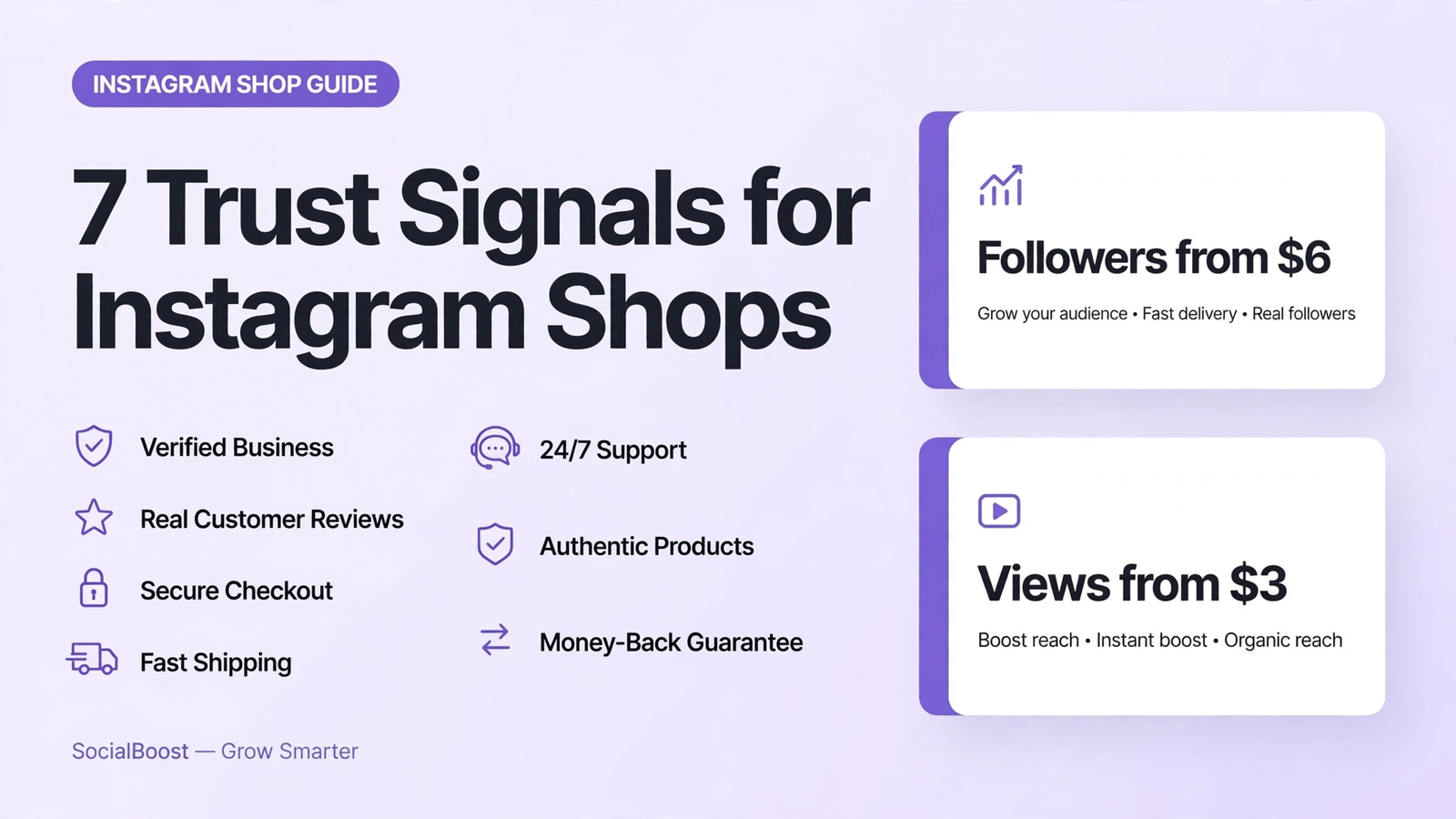
Why Customers Don't Trust New Instagram Shops
Why customers don’t trust new instagram shops has little to do with whether the shop is honest. Shoppers distrust new shops for three reasons that apply to honest and dishonest sellers alike: unfamiliarity (they have never heard of you), no track record (nobody else has visibly bought first), and fear of scams (years of fake shops that took payment and vanished have trained caution into every buyer). None of those reasons is an accusation — they are a description of what a stranger can see. And what a stranger can see is exactly what you can change.
Picture the shopper’s real decision: two vendors, the same product, the same price. The shopper cannot inspect either product, so they judge entirely on signals — the profile photo, the bio, the follower count, how fast the seller replies, whether past customers are visible. The vendor whose signals agree wins, even if the other vendor’s product is slightly better. That is the whole game of Instagram selling in 2026: your signals are your shopfront, and shoppers buy the shopfront they believe.
The stakes are higher than most sellers realise. Surveys of online shoppers repeatedly find that trust influences purchase decisions more than price — one widely cited figure puts it at 81% of consumers — and that a large majority will avoid a business entirely after a single negative review. For an Instagram shop, that means trust is not a nice-to-have brand exercise; it is the conversion mechanism itself. Get the signals right and price stops being the objection. Get them wrong and no discount will save the sale.
Trust Signals for Instagram Business Account: The 7-Signal Checklist
Trust signals for instagram business account owners come down to seven checks a visitor runs, usually unconsciously, in under a minute. The checklist is: (1) a coherent, current presence with no dead grid, (2) a bio and pinned posts that answer what, who, and how to buy, (3) review and customer-content Highlights, (4) fast, human DM replies, (5) transparent pricing and policies, (6) proof of real customers, and (7) identical details everywhere you sell. Work through them in order, because a shop that fails signal one rarely gets judged on signal six — the visitor has already left.
| # | Trust signal | What the visitor checks | Pass mark |
|---|---|---|---|
| 1 | Current, coherent presence | Last post date, grid consistency | Posted within the last week |
| 2 | Bio + pinned posts | What you sell, who it is for, how to buy | Answered in 10 seconds |
| 3 | Review / UGC Highlights | Real customers, recent dates | At least 5 recent entries |
| 4 | DM responsiveness | Reply speed, human tone | First reply within hours |
| 5 | Transparent pricing & policies | Prices, delivery, returns visible | No "DM for price" hiding |
| 6 | Proof of real customers | Unboxings, tagged posts, testimonials | New proof every few weeks |
| 7 | Cross-platform consistency | Same name, prices, contact everywhere | Zero contradictions found |
Keep this table as your monthly audit. Open your profile as a stranger once a month, run the seven checks, and fix the weakest one first — not the easiest one. Shops that improve one signal per month are unrecognisable within half a year, and they never had to go viral to get there.
Signal 1: A Living, Current Profile (No Dead Grids)
Signal 1 is a living, current profile, and it is the signal that kills the most new shops before any other signal is judged. A grid whose newest post is four months old reads as a closed shop, however good the products were. A grid with three posts total reads as untested. A grid that jumps randomly between unrelated topics reads as unfocused. Shoppers do not analyse this — they feel it in the first scroll, and the feeling is "this might not be running any more".
The fix is a sustainable rhythm, not a posting frenzy. Three to five posts a week plus daily Stories is enough for most shops, and consistency beats volume: a shop that posts every Tuesday and Friday looks more alive than a shop that posts twenty times in one week and then vanishes for a month. If you sell through Instagram, your grid is also your catalogue — keep best sellers visible, archive discontinued lines rather than deleting the proof they generated, and never let a seasonal gap (holidays, stock delays) look like abandonment: one Story explaining "back on Monday with new stock" preserves more trust than silence. For the posting rhythm that keeps a profile alive, our social proof guide explains how visible momentum and real engagement reinforce each other.
Signal 2: A Bio and Pinned Posts That Answer Everything
Signal 2 is a bio and pinned posts that answer the visitor’s three questions in ten seconds: what do you sell, who is it for, and how do I buy it? A bio that says "DM for orders ✨ | blessings | est. 2024" answers none of them. A bio that says "Hand-poured candles, Manchester — shop below, delivery across the UK in 2–3 days" answers all three, and the visitor who gets answers stays. For any seller asking how to look trustworthy selling on instagram, this ten-second test is the place to start: if a stranger cannot answer what, who, and how to buy from your bio alone, no other signal will compensate. Pin three posts to lock the answers in place: your best seller, your strongest customer story, and a how-to-order post.
Two details matter more than owners expect. First, the contact path must work on the first tap: a WhatsApp link that opens a chat, a booking link that loads, a shop link that is not broken. A dead link is a trust signal in reverse — it tells the visitor nobody is maintaining this shop. Second, say how to pay and how delivery works before the visitor has to ask, because "DM for price" is read by cautious shoppers as "the price depends on how much I think you will pay". Transparent shops win cautious shoppers; secretive shops lose them before the conversation starts.
Signal 3: Review Highlights and Signal 4: Fast, Human Replies
Signal 3 is review and customer-content Highlights, and signal 4 is fast, human DM replies — together they are the two signals that most directly answer "are other people happy, and will the seller talk to me?" For reviews, build a Reviews Highlight and a Results Highlight, fill them with screenshots of real customer messages (with permission), and refresh them every few weeks so the newest entry is never months old. A Reviews Highlight with two entries from last year is worse than none, because it suggests customers stopped being happy. For the system that fills those Highlights automatically, see our section on getting reviews below.
For replies, speed and humanity both count. A first reply within a few hours, in a human tone that answers the actual question, converts cautious visitors at a rate no automated message matches. Set up quick replies for the five questions you get most — price, delivery time, stock, returns, custom orders — but always follow the quick reply with a personal line, so the visitor knows a person read their message. And reply publicly to comments, not just DMs: a visitor deciding whether to message you will read how you treated the last ten commenters, and that public record is itself a trust signal.
Signal 5: Transparent Pricing and Policies
Signal 5 is transparent pricing and policies: show prices or price ranges on the product posts themselves, state delivery times and costs, and publish a returns policy a visitor can find without asking. Every hidden price is a moment of doubt, and doubt is what cautious shoppers cannot afford — they will simply choose the seller who showed the price. The same applies to policies: "returns within 14 days, buyer pays return postage" is more trustworthy than a vague "we want you to be happy", because specifics are checkable and vagueness is not.
Transparency also covers the unglamorous parts: stock honesty ("only 3 left — restock Friday" beats a fake "selling fast" on every post), delivery honesty (if UK delivery takes five days, say five days), and limitation honesty (if you do not ship internationally, say so in the bio, not after the order). Shops that are honest about limits are believed about everything else; shops that oversell one detail are doubted on all of them. This is also where a credible-looking base helps the signals agree: SocialBoost’s Instagram Followers start at $6 for 1,000 followers, so a shop with strong reviews and clear policies does not look empty next to its own evidence. Read our honest guide to buying social proof before deciding whether a kickstart fits your shop.
Signal 6: Proof of Real Customers — and Signal 7: Consistency Everywhere
Signal 6 is proof of real customers, and signal 7 is consistency everywhere you sell. Real-customer proof means unboxing reposts, tagged posts, delivery photos, and testimonials that a visitor could, in principle, verify — a tagged customer account, a dated screenshot, a recognisable product in a real home. Stock photos of the product alone are not proof; a customer’s kitchen table with your product on it is. Aim for one new piece of customer proof every week or two, and repost it within hours of receiving it, while it is still fresh evidence rather than archive material.
Consistency means the same shop everywhere: the same business name, the same prices, the same contact details, and the same promises on Instagram, on your website, on WhatsApp, and on any marketplace. Shoppers cross-check, often without realising it — they open your website from your bio, compare the price with the post, and check whether the WhatsApp number matches. Every mismatch is a small alarm, and two mismatches are enough for most cautious buyers to walk away. Audit this quarterly: open every channel as a stranger and confirm they describe the same business. The 70/30 rule ties the signals together: roughly 70% of your content should give value — tips, stories, customer results, behind the scenes — and only 30% should directly sell. A feed that is 100% selling reads as desperate; a feed that teaches and shows proof earns the right to sell.
Instagram Trust Badges Explained — and Verified vs Trustworthy Instagram
Instagram trust badges explained, plainly: the blue verified tick means Instagram confirmed an account is the authentic presence of a notable person, brand, or entity — it is an identity check, not a quality certificate. A verified scammer is still a scammer, and an unverified honest shop is still honest. Other badges visitors notice include the business-account labels, shop and product tags (which show a catalogue is connected), and platform features like subscriptions or broadcast channels. None of them certify that a seller will deliver, refund, or reply.
Verified vs trustworthy instagram is therefore a distinction every small seller should be glad exists: you cannot buy or fake your way to a blue tick, but you can out-trust a verified account on every signal that actually decides a purchase. A verified brand with unanswered comments, hidden prices, and no recent reviews loses to an unverified shop with a Reviews Highlight, same-day replies, and transparent policies — because the shopper’s question was never "is this account notable?" but "will I get what I paid for?" Do not chase the tick. Chase the seven signals, and let the tick, if it ever comes, be decoration on trust you already built.
How to Get Reviews on Instagram (Without Begging or Faking)
How to get reviews on instagram without begging or faking is a system, not a plea. Step 1: ask at the happiest moment — in the delivery message or the day the customer receives the product, when satisfaction is highest. Step 2: make it effortless — one question ("one line about your order?"), one place to send it (a DM, not a form), and permission to share it. Step 3: thank publicly — every review you post with thanks encourages the next customer to send theirs. Step 4: keep the loop visible — a Reviews Highlight that grows weekly is itself an incentive, because customers like seeing their words featured.
What not to do matters as much. Never offer payment or discounts in exchange for a positive review without disclosing it, and never present a review that is not from a real customer — fake reviews are now policed by regulators as well as platforms, and one exposed fake destroys the credibility of every real review on your profile. Handle negative reviews in public, gracefully: a calm, specific reply to a complaint ("we have refunded you and fixed the packaging") is read by future visitors as stronger proof than ten five-star screenshots, because it shows what happens when things go wrong. That is the signal cautious shoppers actually want.
Building Credibility as Instagram Seller: Your 30-Day Plan
Building credibility as instagram seller is a 30-day plan, not a one-day redesign. Week 1: fix signals 1 and 2 — post daily, rewrite the bio, pin the three key posts, and repair every link. Week 2: build signals 3 and 6 — message your last twenty customers for reviews, create the Reviews Highlight, and repost the first customer photos. Week 3: fix signals 4 and 5 — set up quick replies, publish prices and policies on your top posts, and answer every comment within a day. Week 4: fix signal 7 — audit every channel for matching details, and start the 70/30 content rhythm for the month ahead.
Measure the right thing: not follower count, but enquiry-to-sale rate and the share of visitors who message after viewing your profile. When those rise, your signals are working. When they do not, run the seven-signal audit again and fix the weakest signal, not the easiest. Trust on Instagram is not a mystery and it is not a badge — it is seven visible, checkable habits, repeated until a stranger can verify, in under a minute, that you are exactly who you say you are. Start with the signal you failed today, and let the rest compound from there.
Frequently Asked Questions About Instagram Trust Signals
How to build trust on instagram shop 2026 means displaying seven verifiable signals: a current profile, a bio and pins answering what you sell and how to buy, review Highlights, fast replies, transparent prices and policies, real-customer proof, and identical details everywhere. Shoppers buy from the shop whose signals agree.
Trust signals for instagram business account owners are the checks visitors run in under a minute: recent posts, a clear bio, review Highlights, reply speed, visible prices and policies, customer photos, and cross-platform consistency. Fix the weakest signal first, not the easiest one.
Why customers don’t trust new instagram shops is unfamiliarity, no visible track record, and fear of scams — not an accusation against your shop. The fix is displayed evidence: early reviews, customer photos, a clear offer, and fast replies, so a stranger can verify you quickly.
Instagram trust badges explained: the blue tick confirms identity for a notable account, not quality or honesty. A verified account can still disappoint, and an unverified shop with reviews, fast replies, and transparent policies can be far more trustworthy where it matters.
How to get reviews on instagram: ask at the happiest moment (delivery day), make it effortless (one line by DM), ask permission to share, and thank reviewers publicly. Never buy or invent reviews — one exposed fake destroys the credibility of every real review on your profile.
Building credibility as instagram seller starts with a 30-day plan: week one fixes the bio, pins, and posting rhythm; week two builds review Highlights; week three fixes replies, prices, and policies; week four audits every channel for matching details. Measure enquiry-to-sale rate, not follower count.